


The nuclear-for-AI thesis is no longer theoretical. For Southeast Asia, nuclear is no longer a question of if the technology works. It’s how the whole ecosystem actually gets there.
Surging AI demand has collided with grid constraints, and a sharpened sense of energy-security risk has pushed governments across the region to give nuclear a serious second look. The six focus markets — Singapore, Malaysia, Indonesia, the Philippines, Thailand, and Vietnam — already host more than 2,000 data centers, with many more in the pipeline. The region's data center market, valued at $13.71 billion in 2024, is projected to more than double to $30.47 billion by 2030, growing at a compound annual rate of 14.23%. The demand is real. The power behind it has to come from firm, clean, and always-on baseload, and that’s where SMRs enter the picture.
While policy support for nuclear is strengthening across SEA, deployment feasibility depends on more than technological readiness. In practice, it is shaped by regulatory capacity, financing clarity, safety governance, and public trust — all of which determine the trajectory of nuclear adoption across the region.
To understand how nuclear, including SMRs, could power Southeast Asia’s rapidly expanding data center sector, Earth VC has developed a set of proprietary analytical models in our report Nuclear Energy Fuels AI Boom in Southeast Asia Data Centers. These frameworks synthesize insights from our research process and market data to identify the technical, financial, and ecosystem conditions shaping SMR deployment. Together, the models provide a structured lens to evaluate market readiness, stakeholder dynamics, and the potential pathways through which nuclear energy and SMRs could emerge as viable energy solutions for the region’s growing digital infrastructure.
Five frameworks. Each answers a different deployment question: where to enter, how to finance, who needs to align, and what must be de-risked.
Framework 1: Nuclear Regulatory Readiness Map
The question: Where in Southeast Asia is the ground actually ready?
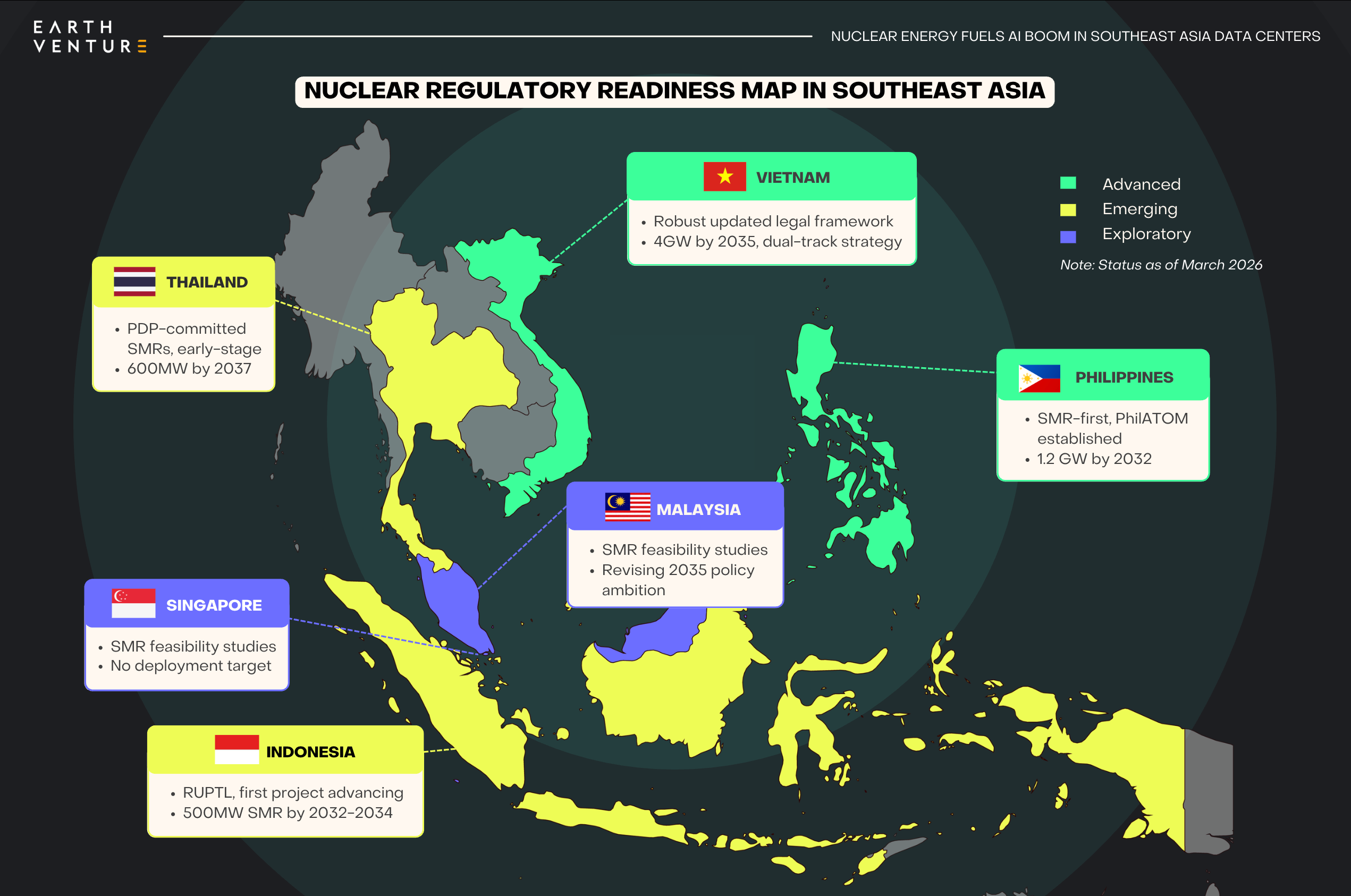
Nuclear deployment doesn't happen at one speed across a region. It happens country by country, each moving at the pace of its own legal frameworks, policy commitments, and institutional capacity. The Readiness Map sorts the six primary SEA markets into three tiers — Advanced, Emerging, Exploratory — showing where first-of-a-kind (FOAK) SMR projects are most likely to materialize.
Framework 2: SMR Bankability Assessment Radar
The question: What makes an SMR project financeable, not just buildable?
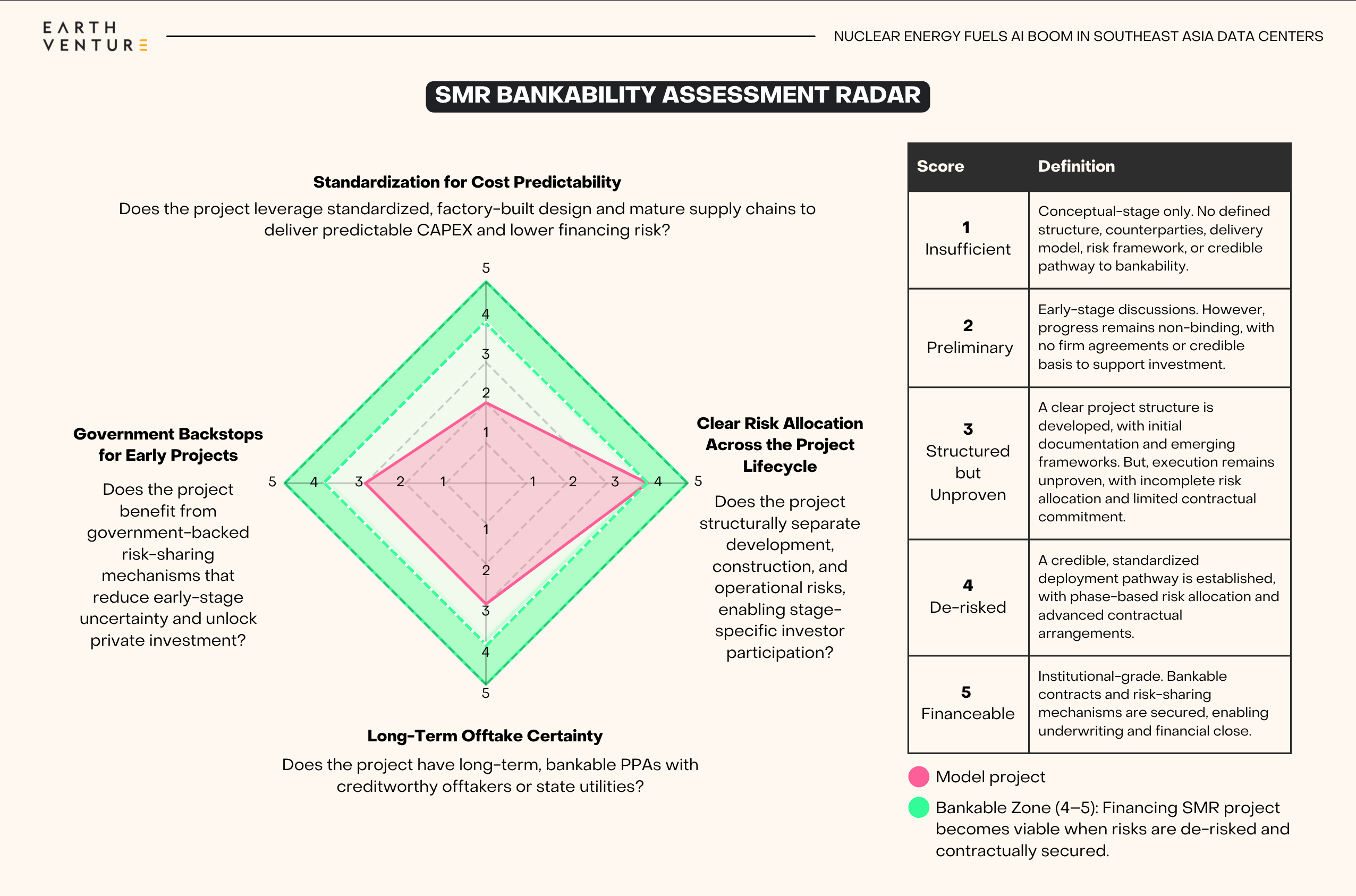
While SMRs have the potential to become cost-competitive over the long term, FOAK deployment requires significant upfront investment and sustained policy support. SMR bankability will therefore depend on how financial, regulatory, and contractual risks are allocated among governments, developers, and offtakers.
Our stakeholder interviews surfaced four conditions as prerequisites for bankability. A project enters the Bankable Zone when it scores 4–5 across these axes — when risk is de-risked and contractually secured, financing becomes viable.
Framework 3: The SEA Market Entry Matrix for SMR Developers
The question: Given where a market stands, what should a developer actually do?
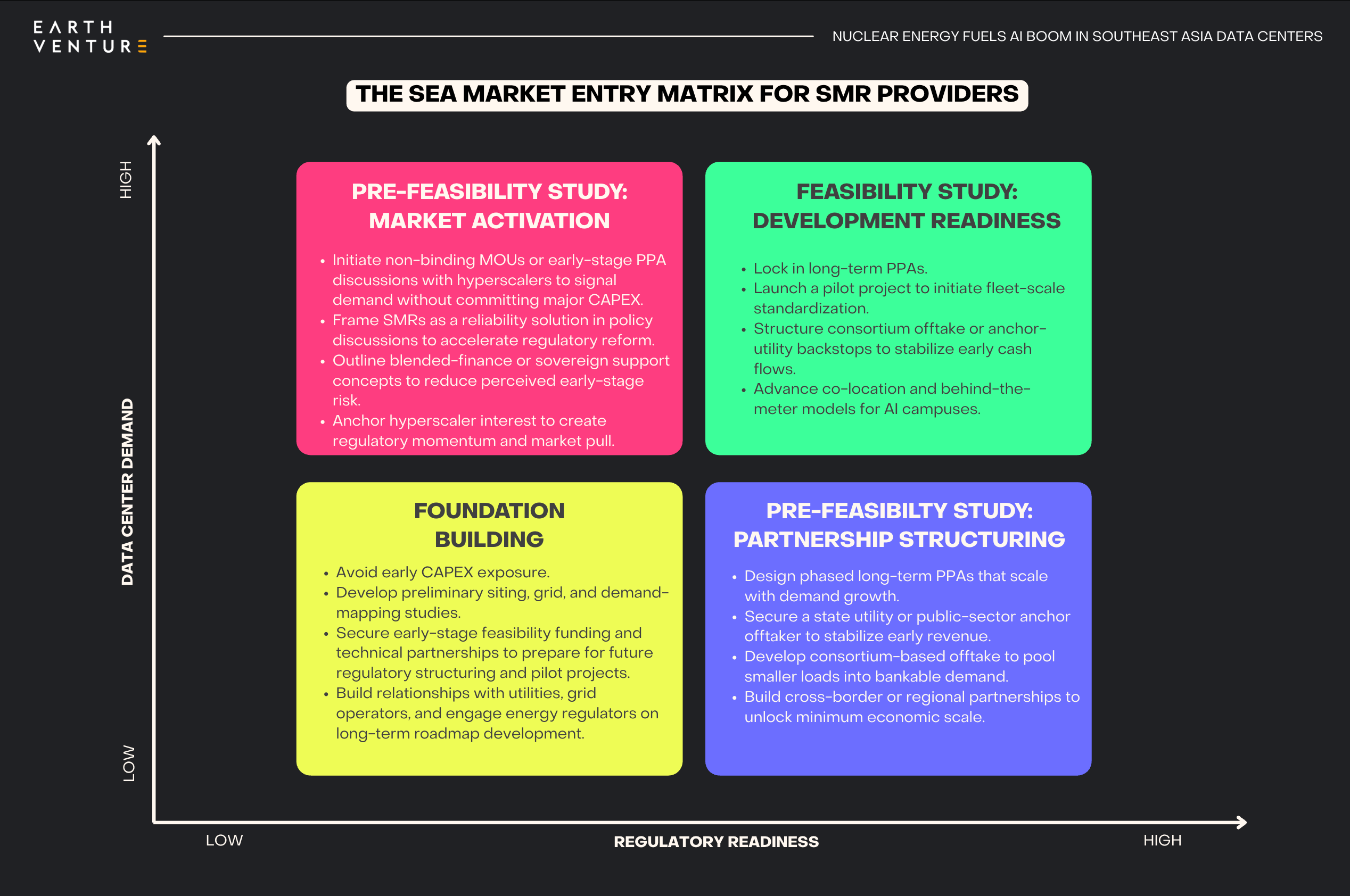
This matrix outlines strategic entry pathways for SMR providers in Southeast Asia, based on two critical variables: data-center demand and regulatory readiness. By mapping markets across these dimensions, it highlights how developers can sequence their actions to align SMR projects with the region's evolving digital infrastructure demand. There's no single right move for Southeast Asia. There's a right move for each market's position.
Framework 4: SMR–Data Center Financing Decision Tree
The question: Who owns what, and who carries which risk?
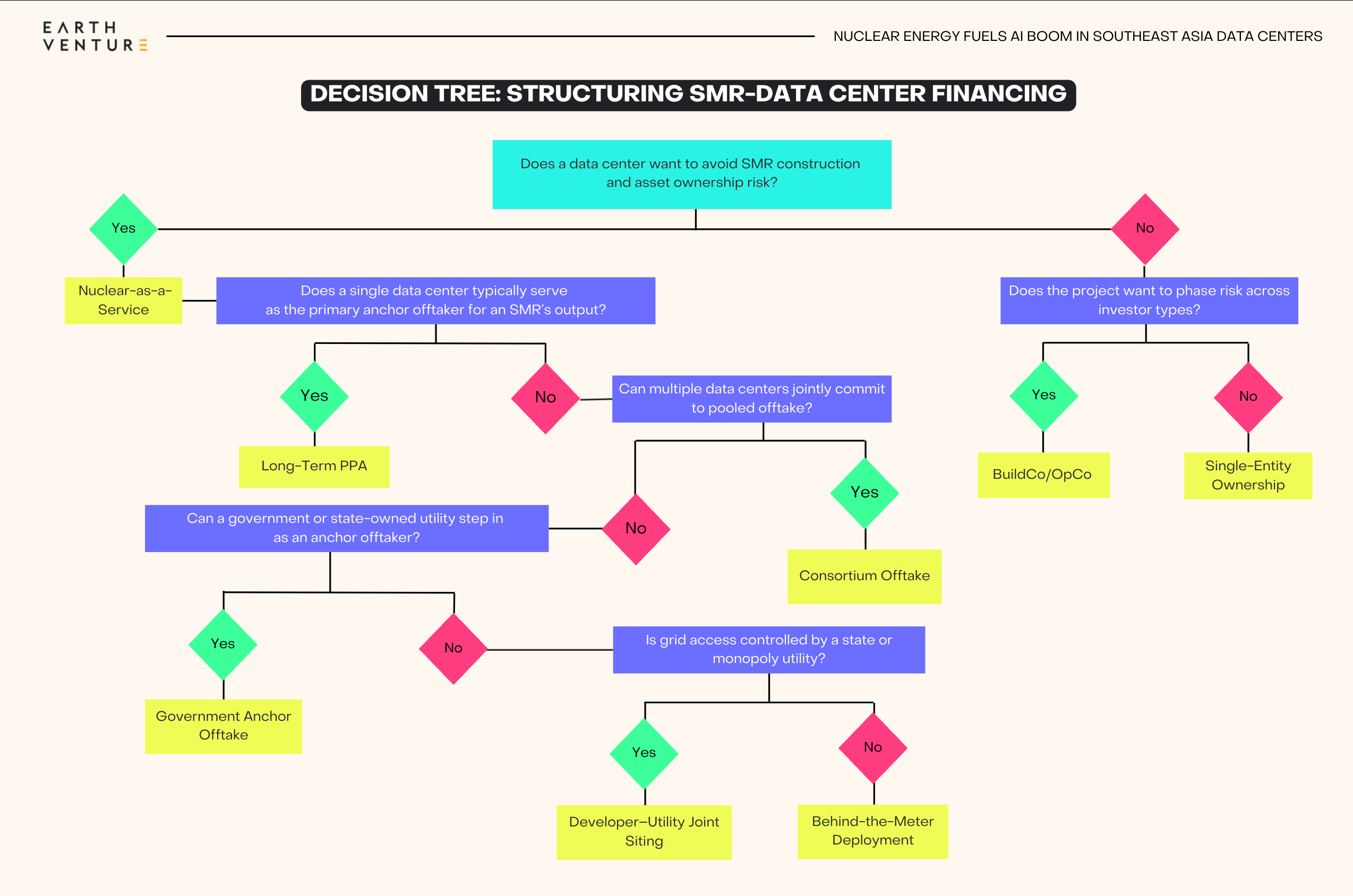
Given the high upfront capital cost of SMRs, financing has to extend beyond traditional utility structures. The Decision Tree walks developers and operators through the key questions — risk tolerance, offtake structure, grid access — to the ownership and financing model that fits their situation. No single model wins; projects adopt different structures depending on risk appetite, offtakers, and grid access.
Framework 5: Roadmap for De-Risking SMR Deployment in Southeast Asia
The question: In what order does all of this have to happen?
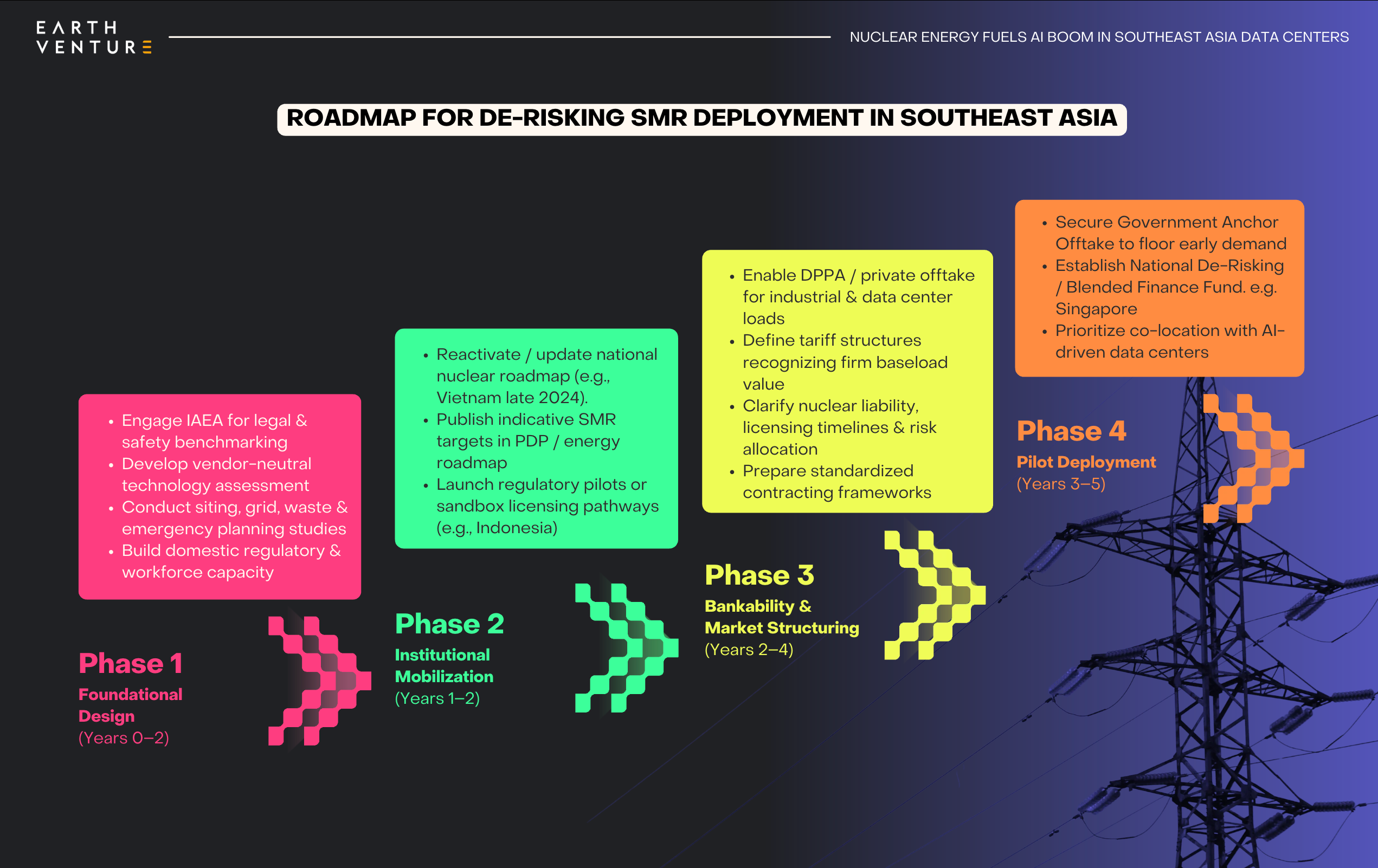
The Roadmap is the throughline — a four-phase pathway over five years that sequences the actions needed to move SMRs from early planning to commercially viable deployment in the region. De-risking isn't one move. It's a sequence. Sequence is strategy. The Roadmap is what keeps the other four frameworks pointing in the same direction over time.
About the Report
The Earth VC report “Nuclear Energy Fuels the AI Boom in Southeast Asia Data Centers“ explores how advanced nuclear technologies, particularly Small Modular Reactors (SMRs), can provide low-carbon, reliable baseload power to fuel Southeast Asia’s (SEA) rapidly expanding digital economy and AI-driven data center growth. The analysis focuses on six key markets where the convergence of digital infrastructure demand and nuclear feasibility is most advanced: Singapore, Malaysia, Indonesia, the Philippines, Thailand, and Vietnam. The research combines extensive desk research with 15 in-depth interviews conducted across policymakers, investors, data center operators, SMR developers, and domain experts—resulting in a distinctive set of frameworks and proprietary insights for the region.